
They Built a Machine to Save the Forests. Then They Handed the Keys to the Logging Industry.
The Fix Our Forests Act has bipartisan support, environmental endorsements, and genuine good intentions behind it. It is also one of the most dangerous pieces of forestry legislation in a generation.

Right now, a bill called the Fix Our Forests Act is waiting to be called to the Senate floor for a vote. This bill has already passed the House 279 to 141 though amendments have been made. It has the support of the Nature Conservancy, the National Wildlife Federation, the Environmental Defense Fund, and the National Audubon Society. Democratic senators Hickenlooper and Padilla are lead sponsors. Governors Newsom, Polis, and Gianforte all endorsed it.
So why should you be worried? Because the bill was written for a Forest Service that no longer exists. And the one we have now might as well be run by the timber industry.

What The Bill Will Do
The Fix Our Forests Act creates a new legal concept called a fireshed management area. Similar to a watershed, a fireshed is a landscape zone, typically around 250,000 acres, roughly the size of a small county, defined by shared wildfire exposure patterns. The bill allows the Forest Service to designate high-risk firesheds as fireshed management areas, which then allows a set of expedited authorities that do not apply to ordinary national forest land.
The issue? The designation of a fireshed management area is itself exempt from National Environmental Policy Act (NEPA) review. The law that requires federal agencies to analyze environmental impacts before acting, and to let the public weigh in. Skipping it means that the agency can draw a 250,000-acre zone around a forest and fast-track logging operations inside it and no one can object.
A fireshed management area can also encompass multiple firesheds. So the actual footprint of a single designation could run far beyond 250,000 acres.
How This Bill Changes the Current Laws
Inside those fireshed management areas, and across national forests more broadly, the bill dramatically expands what are called categorical exclusions from NEPA, the mechanism by which agencies skip full environmental review for projects deemed low-impact. The table below shows you what those exclusions used to be and what this bill would allow them to be.
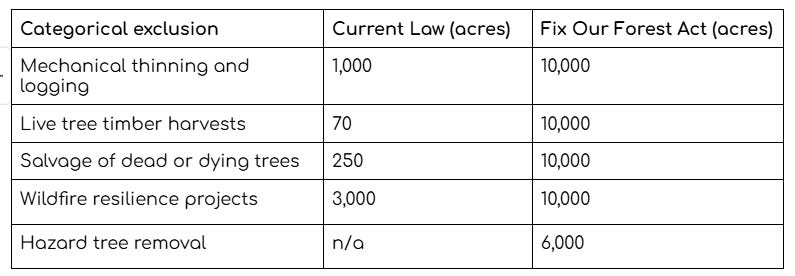
Mechanical logging has a tenfold increase and live tree harvests has more than a 140-fold increase. None of the above would trigger the environmental review. A process that has historically been the public’s main opportunity to push back. And once you are inside a designated fireshed management area, those already expanded authorities are further accelerated.
This is not streamlining. This is the structural removal of oversight.
The Machine and the Operator
Now here is where the bill’s supporters and its critics are, in a narrow sense, both right.
Supporters argue that western forests are genuinely overstocked. Over a century of aggressive fire suppression has left millions of acres with dense undergrowth that burns catastrophically. Thinning, prescribed fire, and active management in the right places, done by the right people with the right science, can reduce fire risk. The Senate version of the bill is meaningfully better than the House version. It codifies Indigenous cultural burning practices. It requires a watershed study from the National Academy of Sciences.. It removes a provision from the House bill that would have stripped your legal standing to sue if you had not formally commented during a public process.
Critics argue that the bill’s deregulatory machinery is designed for commercial logging as much as ecological restoration. The definition of what qualifies as a “fireshed management project” is broad enough to include virtually any timber harvest framed as hazardous fuels reduction. The bill eliminates the Cottonwood legal precedent, which required the Forest Service to reinitiate endangered species consultation when new information emerged. It shortens the window to file a legal challenge from six years to 150 days. And it caps what courts can actually do even when a challenge succeeds.
Both sides are describing the same machine. They just trust different operators.
The USFS We Knew No Longer Exist
The Fix Our Forests Act was drafted in 2023. At that time, the Forest Service was led by career civil servants with backgrounds in ecology and land management. The implicit assumption behind every provision in the bill is that agencies would exercise their new discretion responsibly, that expedited review would be used for genuinely low-impact projects, that the science-based Wildfire Intelligence Center would guide decisions rather than timber economics.
That agency? She gone.
The current Chief of the Forest Service is Tom Schultz. Before this appointment, Schultz was a senior executive at Idaho Forest Group, one of the largest private timber companies in the Pacific Northwest. He was appointed by the Trump administration, which has already issued an executive order seeking to increase timber production on public lands by weakening the Endangered Species Act. Agriculture Secretary Brooke Rollins has declared 112 million acres of national forest, roughly 59% of the entire National Forest System, an “emergency situation” in order to ease large-scale logging operations. USDA finalized a rule in April 2026 consolidating NEPA regulations department-wide, cutting review timelines by up to a whopping 80%.
The same administration that declared a fire sale on our national forest, led by a Forest Service chief from the private timber industry, would be the one deciding which 250,000-acre zones get designated as fireshed management areas. And once designated, projects inside those zones can proceed at ten times the scale previously allowed without full environmental review.
The Environmental Defense Fund included a caveat in their endorsement which was “Successful implementation requires the Forest Service to be appropriately funded and staffed.” I would add that it also requires the Forest Service to be led by people who are not from the industry that benefits from the bill’s passage.
What Tribal Nations Are Being Promised
The Senate bill does codify Indigenous cultural burning practices, which is genuinely meaningful. Tribes across the West have been fighting for decades to restore prescribed fire as a land management tool, and federal law has historically treated cultural burning as a liability rather than an asset. That codification will have a legit impact on our forests. The Southern Ute Indian Tribe, the National Congress of American Indians, and other tribal entities came out in support of the bill specifically because of it.
But when do Tribes get consulted? Because it is not when their consultation would have the greatest impact.
The initial fireshed management area designations happen automatically upon enactment, drawn from existing Forest Service risk maps. The Secretary of Agriculture makes those determinations in consultation with the Secretary of the Interior. In the current administration, these agencies are now run by two people who have nothing to lose but all the profit to gain. There is no formal tribal consultation requirement, no government to government process, and no NEPA review at this stage. Tribal nations do not get a seat at the table when the zones covering their ancestral lands are drawn.
Once a fireshed is designated, the bill requires an assessment within 120 days. Tribes are supposed to be “coordinated with” during this process but only if they are already party to an existing formal agreement with the Forest Service under Section 104. Only 120 of the 574 federally recognized tribes have that agreement. So that table? It just got a hell of a lot smaller.
And let’s not bullshit this, “coordinate” is not “consult.” Under the federal government’s trust responsibility to tribal nations, formal consultation is a government to government process with specific legal standards. Coordination is an unenforceable standard that falls well short of what that trust responsibility requires.
Section 106, which governs emergency fireshed management, is where tribal protections are basically nonexistent. The Southern Ute Indian Tribe, one of the bill’s supporters, flagged this directly in their letter of support. They recommended that the bill require formal tribal consultation before emergency fireshed management activities occur within the boundaries of an Indian reservation, writing that tribes are most familiar with their own lands and that any actions on tribal lands must be coordinated with the tribe to ensure protection of natural and cultural resources.
The Southern Ute also asked for a third modification: that the 150-day window to file a legal challenge be extended for tribes. The compressed litigation timeline that critics have pointed at as a problem for the general public is an even more acute problem for tribal nations, who may not have the personnel to identify, research, and file a challenge in 150 days.
The cultural burning provisions, while great, do not offset a designation process that bypasses tribal sovereignty, an assessment process that uses a weaker standard than federal trust responsibility requires, and an emergency authority that can move faster than tribes can respond. A bill that genuinely centered tribal nations would have required government to government consultation before any fireshed management area was drawn, not after.
Does Logging Equal Wildfire Prevention? Science Has Determined That Is A Lie
Set aside the politics for a moment. What does the science actually say about logging as wildfire prevention? The relationship is more complicated than either side acknowledges, but a few things are well established.
The trees most resistant to wildfire are the oldest and largest ones. Older ponderosa pines, for example, have thick, fire-resistant bark and high canopies that keep fire from climbing into the crown. Removing those trees and replacing them with younger, denser, more flammable growth does not reduce fire risk. It increases it.
A 2023 study published in Science found that only about one-third of structures destroyed by wildfire were in forested vegetation. The majority of homes were lost in grasslands, shrublands, and other non-forest ecosystems. The science consistently shows that the most effective way to protect homes from wildfire is home hardening and defensible space, not backcountry logging projects miles from any community.
Meanwhile, the Fix Our Forests Act appropriates no new dedicated funding for home hardening or defensible space. It does, however, create extensive new ways to expedite timber sales.
Did the Logging Industry Write this Bill?
There is a version of this bill that would be worth supporting. It would invest heavily in prescribed fire and Indigenous cultural burning. It would fund home hardening programs at scale. It would build the Wildfire Intelligence Center with genuine scientific independence. It would treat active forest management as a scalpel rather than a chainsaw.
Some of that version is in the Senate bill. The prescribed fire provisions, tribal burning codification, and the Wildfire Intelligence Center is all well and good.
But.
This bill still hands a dramatic expansion of commercial logging authority to an administration that has made no secret of its intention to use wildfire as a pretext for opening public forests to industrial scale timber extraction.
That is not a conspiracy theory. This is the stated policy of this administration, implemented by a Forest Service chief from the private timber industry, operating under an emergency declaration covering nearly 60% of the national forest system.
What You Can Do
The Senate has not voted yet. S. 1462 is on the calendar but has not been called to the floor. That means there is still time.
Call your senator. The Capitol switchboard is 202-224-3121. You do not need a prepared speech. Tell them you oppose S. 1462 and that you want to see a wildfire bill that funds home hardening, supports prescribed fire, and does not hand expanded logging authority to an administration that has declared our forests a commercial emergency.
If you want to go further, the organizations doing the most rigorous legal and policy work on this are Earthjustice, Oregon Wild, and Defenders of Wildlife. They can always use your support.
This is a logging handout. Not a meaningful wildfire reduction bill.
Sources: Congress.gov S.1462 full text and section-by-section summary; GAO-25-107496 Forest Service Timber Sales 2014-2023; Environmental Defense Fund press statement April 2025; Earthjustice press statement April 2025; Defenders of Wildlife press statement April 2025; Resilience.org May 2026; High Country News October 2025; Taxpayers for Common Sense November 2025; Oregon Wild October 2025; USDA NEPA Final Rule April 2026; 2023 Science journal wildfire structures study; Southern Ute Indian Tribe letter of support for S.1462, October 14, 2025.