
Riders, Extractions, and Extinction. Oh My! A Closer Look at the FY2027 Interior Appropriations Act
A look at the speicies being attacke, land being handed to industry, the mechanisms designed to make future legal challenges impossible, and who specifically profits from each one.

I covered riders for the gray wolf, grizzly bear, and wolverine in a previous article that the 119th Congress is trying to strip. You can read about that here.
If you only read the headlines about the FY2027 Interior appropriations bill, you know about the wolves, the grizzlies, and the wolverines. That is no accident. Those three garner enough public attention to generate outrage but there are more than thirty policy riders buried in this single spending bill that affect more than those 3 species. Because of course there are.
The full House Appropriations Committee completed its markup of this bill on June 3rd. Not a single rider was stripped. Every provision described in this article survived the republican led committee vote. The bill now heads to the House floor with all of them.
I was reading the committee’s own summary document which was released alongside the markup and the language used is pretty telling. The committee describes the ESA riders as “prohibiting multiple U.S. Fish and Wildlife Service rulings used to weaponize the Endangered Species Act against land users and energy producers.” That is the official congressional summary that reads more like a political attack ad. This is how the committee chair, Rep. Tom Cole of Oklahoma, feels about wildlife protections. Then there is the the Boundary Waters mining leases, which basically give two named private leases to a Chilean mining company, under the banner of a national security measure to “reduce our reliance on foreign countries for critical minerals.”
The Species the Republicans are Gunning For
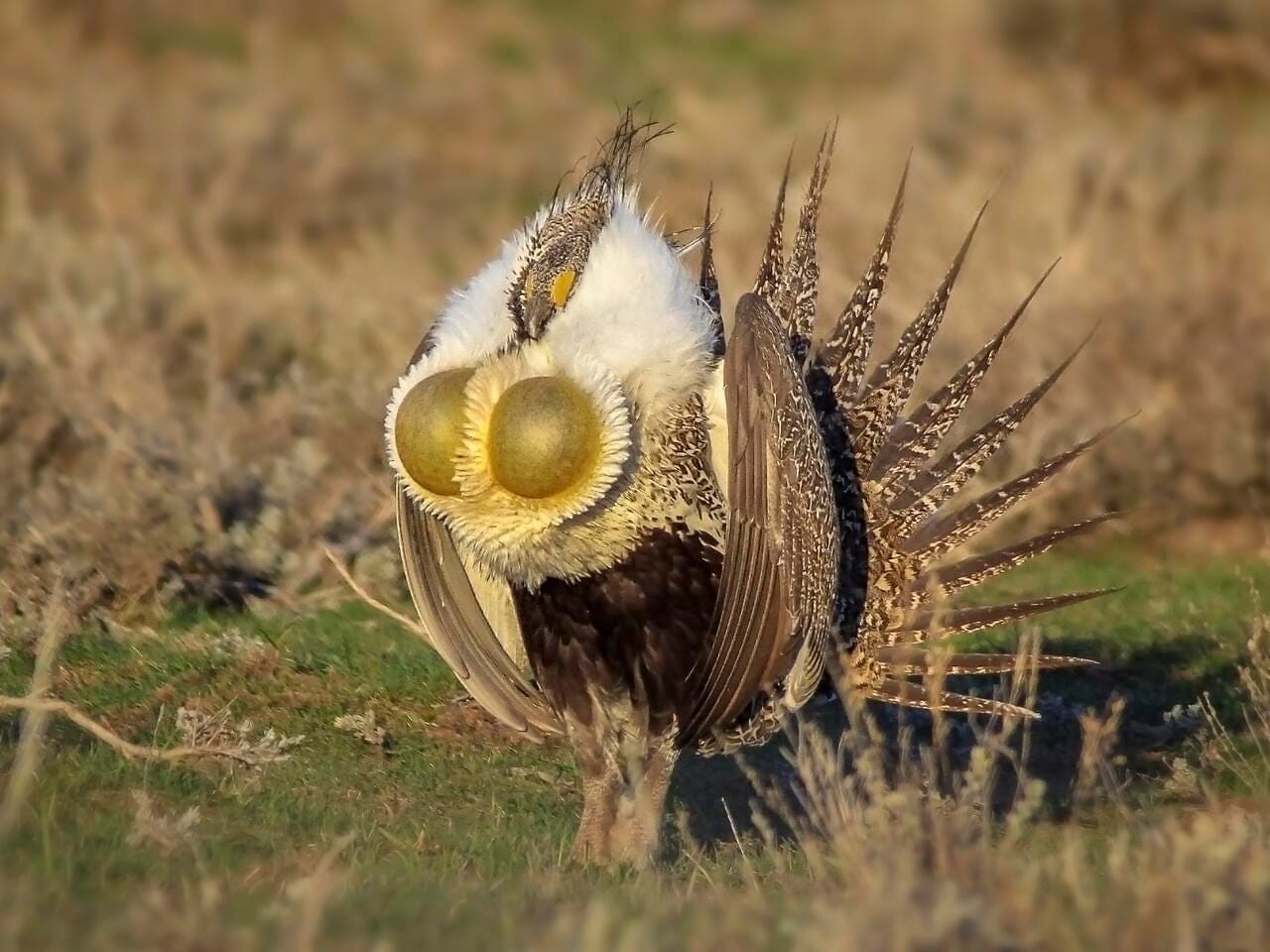
Greater Sage-Grouse (Sec. 116)
What it does: Blocks any funds from being used to list the greater sage-grouse under the ESA or to enforce any listing permanently. This is regardless of what future science shows and can only be undone through an act of Congress.
The sage-grouse is a chicken-sized bird whose booming mating display across the sagebrush of the American West is one of the more extraordinary wildlife spectacles in North America. Its population has declined an estimated 80% since the 1960s. This rider has appeared in virtually every Republican-led Interior bill since 2014. It exists because the sage-grouse’s habitat overlaps almost perfectly with oil and gas drilling territory across Wyoming, Utah, Nevada, Idaho, and Montana. Listing it would trigger habitat protections that constrain drilling. So the rider ensures the listing can never happen regardless of what the science says, and regardless of how far the population falls.
Who benefits: The oil and gas industry operating in the Intermountain West, including ExxonMobil, Chevron, Devon Energy, and dozens of smaller regional operators. The Western Energy Alliance, the oil and gas trade group for western public lands operators, has lobbied against sage-grouse listing for over a decade.
Lesser Prairie-Chicken (Sec. 123)
What it does: Blocks all enforcement of the 2022 listing that designated the lesser prairie-chicken as threatened in its northern range and endangered in its southern range.
This bird has been losing ground for decades because of habitat destruction from agricultural conversion, oil and gas development, wind energy development, and drought. It was listed in November 2022 after a long fight. Section 123 makes that listing meaningless. No money can be spent protecting it. The species occupies shortgrass and mixed-grass prairie across Texas, Oklahoma, Kansas, Colorado, and New Mexico, which is also some of the most intensively drilled and farmed territory in the country. In the 118th Congress the Senate used the Congressional Review Act to try to overturn the listing outright. When that did not work, it ended up as a rider.
Who benefits: Oil and gas operators in the Permian Basin and Anadarko Basin, as well as agricultural interests in the Texas Panhandle and western Oklahoma. The Texas Farm Bureau and Oklahoma Farm Bureau have both publicly opposed the prairie-chicken listing.
Northern Long-Eared Bat (Sec. 124)

What it does: Blocks enforcement of the November 2022 rule that upgraded the northern long-eared bat from threatened to endangered.
White-nose syndrome, a fungal disease introduced from Europe, has killed an estimated 90% or more of some northern long-eared bat colonies since it was first documented in 2006. The Fish and Wildlife Service upgraded the bat’s status to endangered in direct response to that scale of collapse. Section 124 blocks enforcement of that decision. The bat lives across the eastern and midwestern United States, and its listing creates consultation requirements for timber operations. That is why this rider exists. It appeared in the FY2026 House bill too, stripped before final passage, and is now back.
Who benefits: The timber industry operating in the northeastern and midwestern United States. Companies like Weyerhaeuser and PotlatchDeltic have operating interests in the bat’s range, and the American Forest and Paper Association has consistently opposed consultation requirements triggered by bat listings.
Captive ESA-Listed Fish (Sec. 129)
What it does: Blocks ESA enforcement for any fish legally held in captivity that is physically separated from wild populations.
This is meant to sound technical, but it is a direct attack on how captive breeding programs for threatened or endangered fish programs operate.. Captive breeding programs are the last line of defense for some of the most critically endangered fish species in the country, including multiple sturgeon species and various salmon populations being maintained as against wild stock collapse. Those programs operate under ESA-mandated obligations that govern how the fish are handled, bred, and tracked. This rider strips those obligations and has the potential to undermine the legal framework that justifies the programs’ existence in the first place.
Who benefits: This rider appears to be designed to weaken the ESA’s administrative infrastructure broadly, specifically the idea that captive animals can be counted toward a species’ recovery. It is an attack on how the ESA counts population viability, dressed up as a technical provision.
Bison at Charles M. Russell National Wildlife Refuge (Sec. 130)
What it does: Blocks the introduction of bison onto the Charles M. Russell National Wildlife Refuge in north-central Montana.
The CMR is one of the largest national wildlife refuges in the contiguous United States, more than a million acres along the Missouri River. Bison once grazed those grasslands in numbers in the tens of millions. Reintroducing them has been a conservation goal for years. The CMR is surrounded by cattle operations. Ranchers have consistently opposed bison on public land, citing brucellosis risk and competition for forage. Section 130 protects those operations from having to share their federally subsidized landscape with a native species that belongs there.
Who benefits: Cattle ranchers operating on BLM and private land adjacent to the CMR. The Montana Stockgrowers Association and R-CALF USA have both lobbied against bison reintroduction proposals.
The Three Biden-Era ESA Framework Rules (Sec. 131)
What it does: Blocks three interrelated rules finalized by the Biden administration in April 2024 that updated the core regulatory architecture of how the ESA operates.
This is the most sweeping ESA rider in the bill that does not involve a specific species. The three rules together do three things: they strengthen habitat protections for threatened species by closing a loophole that had allowed “take” of threatened animals without permits, they restore the ability of federal agencies to consider climate change in listing and consultation decisions, and they tighten interagency consultation requirements for federal projects. All three were updates that reversed weakening changes made during the first Trump administration. Section 131 rolls the ESA’s entire operational framework back to the weakened version that was in place from 2019 to 2024. It is a system-level reset accomplished by a single rider in a spending bill.
Who benefits: Every extractive industry that operates on federal land and is subject to ESA consultation requirements. Oil and gas, mining, logging, and ranching all face less scrutiny under the weaker framework. The American Petroleum Institute and the National Mining Association lobbied against all three underlying rules.
The “Cottonwood” Interagency Consultation Rider (Sec. 135)
What it does: Orders the Interior Secretary to reinstate a Trump-era rule governing how federal agencies consult with Fish and Wildlife when their projects might affect listed species, replacing a stronger Biden-era standard.
Named after a legal case, this rider reinstates a weaker standard for the most important procedural protection in the ESA: the requirement that federal agencies check with wildlife biologists before approving projects in listed species habitat. The Biden standard required more rigorous analysis. The Trump standard required less. Section 135 puts the less rigorous version back. One sentence. Enormous practical consequences for every future road, mine, pipeline, and timber sale that goes through federal environmental review.
Who benefits: Any company or industry that builds or extracts on federal land and wants faster, less scrutinizing environmental review. The construction, energy, and mining industries are the primary beneficiaries.
North Cascades Grizzly Bear Reintroduction (Sec. 127)
What it does: Blocks all funding for implementing the 2024 rule establishing a grizzly bear reintroduction program in the North Cascades ecosystem of Washington State.
The North Cascades once supported hundreds of grizzly bears. Surveys now suggest fewer than ten remain. The ecosystem is the most viable remaining grizzly habitat in the lower 48 states that currently has no meaningful population. A reintroduction program was finalized in 2024 after years of study and public comment. Section 127 cancels it before a single bear can be moved. The North Cascades is also one of the least heavily ranched landscapes on this list, which makes this rider harder to explain as a pure livestock protection play.
Who benefits: Primarily ranching and hunting interests in Okanogan and Chelan counties in Washington, which border the reintroduction area. Washington Farm Bureau and Washington Cattlemen’s Association both filed formal opposition to the reintroduction.
Bitterroot Grizzly Bear (Sec. 128)
What it does: Separately blocks any attempt to establish an experimental grizzly population in the Bitterroot ecosystem of Montana and Idaho.
This is distinct from the North Cascades rider. The Bitterroot recovery proposal has been proposed, studied, litigated, and killed multiple times over 30 years. Livestock and outfitting interests in the Bitterroot Valley have fought it consistently. Section 128 kills it again, by appropriations rider, with no floor vote and no debate.
Who benefits: Livestock operations and outfitting businesses in the Bitterroot Valley. The Idaho Cattle Association and Montana Stockgrowers Association have been the primary industry opponents of Bitterroot grizzly recovery.
Northern Spotted Owl (Sec. 146)
What it does: Orders the reinstatement of a Trump-era critical habitat designation from January 2021 that was smaller than the Biden-era expanded designation, rolling back habitat protections for the spotted owl.
The spotted owl’s critical habitat has been the most contested wildlife issue in the Pacific Northwest for more than 30 years. The Biden administration expanded the designated habitat to reflect updated science about where the owl needs to survive and recover, particularly as barred owl expansion puts additional pressure on spotted owl populations. Section 146 throws that science-based expansion out and mandates the smaller Trump-era boundary, reopening portions of the owl’s old-growth forest territory to logging. The owl’s story is in many ways explains why the ESA is constantly under attack: it was listed in 1990, it helped end old-growth logging on federal lands, and it has been under sustained attack since.
Who benefits: The Pacific Northwest timber industry. Companies including Weyerhaeuser, PotlatchDeltic, and Stimson Lumber have operating interests in the owl’s habitat and have lobbied consistently against expanded critical habitat. The American Forest Resource Council has been the primary trade group pushing for habitat rollbacks.
Canada Lynx (Sec. 147)
What it does: Blocks a November 2024 proposed rule that would have expanded critical habitat for the Canada lynx.
The Canada lynx depends on boreal forest and deep snowpack for survival. It hunts snowshoe hare almost exclusively and requires the dense cover of mature boreal forest. Both its prey base and its habitat are getting smaller as climate change reduces snowpack across its range. The proposed rule would have expanded critical habitat to reflect that updated scientific understanding. Section 147 freezes protections at the old, smaller boundary, preventing the agency from acting on what its own scientists say the species needs.
Who benefits: Timber operations in northern Minnesota, Maine, Montana, and Idaho that operate within or near the lynx’s habitat. The Minnesota Forest Industries association and Idaho Forest Group have both filed formal opposition to lynx habitat expansions.
Texas Freshwater Mussels (Sec. 502)
What it does: Strips ESA protections for seven freshwater mussel species in Texas rivers: the Guadalupe fatmucket, Texas fatmucket, Guadalupe orb, Texas pimpleback, Balcones spike, false spike, and Texas fawnsfoot. Such fun names, amiright?
These species were listed in June 2024 after population crashes driven by agricultural water withdrawals and agricultural runoff in the Hill Country and Edwards Plateau watersheds. Freshwater mussels are among the most imperiled groups of animals in North America, and the Texas Hill Country rivers are among the most threatened freshwater ecosystems in the United States because of competition over water rights between agriculture, municipalities, and the environment. Listing these species created constraints on how much water can be withdrawn from the rivers they live in. Section 502 removes those constraints. The species are invisible to most voters and have no charismatic appeal. That appears to be the calculation.
Who benefits: Agricultural operations in the Texas Hill Country that depend on water withdrawals from the Guadalupe, San Antonio, and Colorado river systems. The Texas Farm Bureau and Texas and Southwestern Cattle Raisers Association both filed formal opposition to the listing.
They Just Can’t Keep Their Hands Off of Our Public Lands
“Sue and Settle” Rider (Sec. 132)
What it does: Reinstates Trump-era Interior Secretary’s Order 3368, which requires the department to publish public notice in the Federal Register before entering into any consent decree or settlement agreement, and to hold public comment periods before approving settlements with significant policy implications. Biden’s Interior Secretary Deb Haaland revoked Order 3368 in June 2022, calling it “redundant, inefficient and vague.”
This sounds like they are wanting more “transparency,” but the practical effect is to slow down and complicate legal settlements between environmental groups and the Interior Department. The conservation groups use litigation and settlement agreements as a primary tool for forcing the agency to meet ESA listing deadlines that it often misses, mainly due to industry pressure to delay. Order 3368 was originally designed to label those settlements “sue and settle” deals and make them politically costly. Reinstating it creates bureaucratic friction around the settlements that have historically been among the most effective tools for enforcing the ESA.
Who benefits: Industries that benefit when ESA listing deadlines get missed, including oil and gas, mining, and ranching. The more friction around settlements, the longer species wait for protection, and the longer industry operates without constraints.
BLM Conservation Rule (Sec. 133)
What it does: Kills a May 2024 Biden administration rule that established conservation as a formal, equal use of the 245 million acres of BLM-managed public land, alongside grazing, energy development, and recreation.
For most of BLM’s history, the agency has operated under a “multiple use” mandate that in practice prioritized extraction and livestock grazing over conservation. The 2024 rule changed that by creating “conservation leases” that gave restoration and wildlife habitat projects the same legal standing as oil and gas leases and grazing permits. The ranching and extraction industries immediately challenged it in court and lobbied Congress to kill it. Section 133 does exactly that. It means conservation groups cannot compete for BLM land use the way industry can. If this sounds like the “Public Lands Rule” that was rescinded early this month, it’s because it is.
The administration killed the rule administratively. Congress is using a rider to kill it legislatively. One can be undone by the next president. The other requires an act of Congress to reverse. They are not being redundant. They are being thorough.
Who benefits: The oil and gas, mining, and ranching industries that currently dominate BLM land use. The American Petroleum Institute, National Cattlemen’s Beef Association, and Public Lands Council all publicly opposed the conservation rule.
Grand Staircase-Escalante National Monument (Sec. 134)
What it does: Mandates that Grand Staircase-Escalante National Monument be managed according to the 2020 Trump-era management plan that reflected a reduced monument boundary, effectively overriding Biden’s 2021 restoration of the monument to its original size.
Grand Staircase-Escalante was established by President Clinton in 1996. The Trump administration shrank it by nearly half in 2017, reopening large portions to coal and uranium exploration. Biden restored it to its full size in 2021. Section 134 treats Biden’s restoration as if it never happened, without touching the monument’s legal boundary. This is monument management by appropriations rider, reopening coal and uranium leasing in portions of one of the most scientifically significant landscapes in the American West without a vote specifically on that question.
Who benefits: Coal and uranium mining interests in southern Utah. Alton Coal Development and other regional operators had leasing interests in the reduced monument area. The Utah Legislature and Utah Farm Bureau have both lobbied for the reduced management approach.
National Petroleum Reserve in Alaska (Sec. 140)
What it does: Blocks a May 2024 BLM rule that established protections for 13 million acres of the National Petroleum Reserve in Alaska, the largest single unit of federal land in the country.
The protected 13 million acres of the NPR-A include critical caribou calving habitat, migratory bird nesting areas used by species from across the Western Hemisphere, and subsistence lands that Alaska Native communities have depended on for thousands of years. The Biden rule created a special area designation for the most ecologically sensitive portions of the Reserve. Section 140 wipes those protections out, opening the full Reserve to whatever drilling the administration chooses to permit. Similar to the “Public Lands Rule” NPR-A was already rescinded 6 months prior to this bill and just like Sec. 133, Sec. 140 makes overturning this an act of Congress.
Who benefits: Oil and gas companies seeking to expand operations on Alaska’s North Slope, including ConocoPhillips, which is the most active driller in the NPR-A and which has lobbied against the protective designations. The Alaska Oil and Gas Association has been the primary trade group pushing for full NPR-A access.
Ten-Day Notice Rule (Sec. 139)
What it does: Blocks a 2024 update that extended the advance notice period mining operators must provide to BLM before beginning surface disturbance on public land.
The ten-day notice rule gives BLM time to review a mining operation’s plans before work begins. Extending that window from ten days was a modest attempt to give regulators slightly more time to catch problems before equipment is already in the ground. Section 139 blocks that extension, keeping the minimal notice period in place and reducing the agency’s practical ability to intervene.
Who benefits: Hard rock mining companies operating on BLM land across the West. The National Mining Association and Mining Industry Coalition lobbied against the extended notice requirement.
Boundary Waters Mining Leases (Sec. 441)
What it does: Orders the Interior Secretary, within 30 days of enactment, to reinstate two specific hardrock mineral leases in the Superior National Forest in Minnesota, identified as MNES-01352 and MNES-01353, not subject to any judicial review.
This is the most specific and aggressive provision in the entire bill. These are not abstract policy changes. They are two named private leases for a proposed copper-nickel mine on the edge of the Boundary Waters Canoe Area Wilderness, the most visited wilderness in the country and one of the last roadless lake country landscapes in the lower 48. The Biden administration canceled the leases in 2023 after a 20-year mineral withdrawal in the watershed was reinstated. Section 441 brings them back with no court access for anyone who objects. Reinstating named private leases in an appropriations bill, stripping judicial review, is not standard legislative practice. It is a private financial benefit to a specific foreign-owned company written into federal law.
Who benefits: Twin Metals Minnesota, a subsidiary of Antofagasta Plc, the Chilean copper mining giant. Antofagasta retained the Bernhardt Group, the firm founded by former Trump Interior Secretary David Bernhardt, to lobby Congress on the lease reinstatement in 2025, paying approximately $40,000 between April and June 2025 for lobbying of Interior, Congress, and the White House on this specific issue.
Social Cost of Carbon (Sec. 442)
What it does: Bans using the social cost of carbon in any cost-benefit analysis, any rulemaking, any guidance document, or any other agency action, under any law.
The social cost of carbon is the primary economic tool used to quantify the damage caused by greenhouse gas emissions in regulatory decisions. It is how agencies calculate whether the benefit of a new coal lease, oil pipeline, or drilling permit outweighs its climate costs. Without it, climate costs are effectively zero in the regulatory math. Section 442 does not just limit how the social cost of carbon is used. It bans it entirely, permanently, from every agency action under every law. That means every future resource extraction decision on public land gets to ignore its climate impact as a matter of law.
Who benefits: The oil, gas, and coal industries broadly, for whom the social cost of carbon is the single most consequential regulatory tool in terms of constraints on new fossil fuel development. The American Petroleum Institute and the US Chamber of Commerce have lobbied against the social cost of carbon framework for years.
Mining Regulatory Clarity Act Incorporated by Reference (Sec. 443)
What it does: Enacts H.R. 1366, the Mining Regulatory Clarity Act, directly into law by incorporating it into the appropriations bill.
H.R. 1366 weakens environmental review requirements for mining operations on federal land. By tucking it into an appropriations bill as a reference, it becomes law without a standalone Senate vote, without debate on its specific merits, and without the public attention that a standalone mining bill would generate.
Who benefits: The hard rock mining industry on federal lands. The National Mining Association supported the legislation.
Water Rights (Sec. 444)
What it does: Bans federal agencies from requiring the transfer of any water right, in whole or in part, as a condition of issuing, renewing, or extending any grazing permit, lease, or other land use arrangement.
Western water law is governed by states, and ranchers who hold federal grazing permits also frequently hold state water rights for the water on and near that land. Federal agencies have occasionally sought to assert some authority over those water rights as part of managing federal land. This rider ends that permanently. It means ranchers can hold both federal grazing permits and state water rights, with the federal government having zero leverage over the water even when it is critical to the public land ecosystem.
Who benefits: Ranchers who hold federal grazing permits and state water rights in the West, particularly in water-scarce states like Nevada, Utah, Arizona, and Wyoming. The National Cattlemen’s Beef Association and Public Lands Council have consistently pushed for this provision.
No Land Withdrawals Without Congress (Sec. 445)
What it does: Blocks using any federal funds to withdraw public land from mining, drilling, or other resource extraction unless Congress specifically authorizes it.
Presidential land withdrawals have been one of the most powerful executive tools for protecting public land, used by presidents of both parties. Obama used it for Bears Ears and Grand Staircase. Trump used it to reopen those monuments. Biden used it for the Boundary Waters watershed. Section 445 ends that. Every future withdrawal requires an act of Congress, where industry lobbying is concentrated and where a single senator can block action indefinitely. The practical effect is to make land protection functionally impossible without bipartisan congressional support.
Who benefits: Every industry that has faced or fears facing a presidential land withdrawal: mining, oil and gas, uranium. The National Mining Association and American Petroleum Institute have both supported this restriction for years.
Allegheny National Forest Mineral Rights (Sec. 446)
What it does: Blocks any regulation of oil and gas development on privately owned mineral rights within the Allegheny National Forest in Pennsylvania.
The Allegheny has an atypical legal situation where private mineral rights exist beneath federal surface land, a legacy of how the forest was assembled in the early 20th century. Federal agencies have tried to regulate how those private operators extract on federal surface land. Section 446 removes that regulatory authority. Private mineral rights holders can drill beneath the Allegheny with no federal oversight of how they do it.
Who benefits: Private oil and gas mineral rights holders in the Allegheny National Forest, primarily small and mid-size Pennsylvania operators. The Pennsylvania Independent Oil and Gas Association has lobbied for this provision.
Hunting, Fishing, and Recreational Shooting Access Lock-In (Sec. 437)
What it does: Prohibits using any federal funds to close federal land to hunting, fishing, or recreational shooting if that access existed as of January 1, 2013, with exceptions only for temporary closures of up to 30 days for safety or special events.
This rider makes it nearly impossible for agencies to restrict hunting or fishing on public land for conservation reasons without an act of Congress. Meaning that if a wildlife population crashes and biologists recommend closing a federal land unit to hunting while recovery efforts proceed, that closure is blocked if the land was open on or before January 1, 2013.
Who benefits: Hunting and fishing access advocates, including the National Rifle Association, the Congressional Sportsmen’s Foundation, and the Safari Club International. The NRA has pushed for this type of provision across multiple appropriations cycles.
Livestock Greenhouse Gas Permits Banned (Sec. 432)
What it does: Bans using Clean Air Act Title V permit requirements for greenhouse gas emissions from biological livestock processes including carbon dioxide, methane, nitrous oxide, and water vapor.
Agriculture is responsible for approximately 10% of total US greenhouse gas emissions, with livestock being the single largest source within that sector. Methane from cattle digestion and manure management is a potent greenhouse gas. Section 432 permanently blocks applying Clean Air Act permitting to those emissions, meaning feedlots and factory farms can never be regulated for their greenhouse gas output under the primary law governing air emissions.
Who benefits: Large-scale livestock producers, feedlot operators, and concentrated animal feeding operations. The National Pork Producers Council, National Cattlemen’s Beef Association, and American Farm Bureau have all supported this provision.
Livestock Manure GHG Reporting Banned (Sec. 433)
What it does: Bans mandatory greenhouse gas reporting requirements from manure management systems.
This bill bans the collection of data on manure-related greenhouse gas emissions. You cannot regulate what you do not measure. This rider ensures the regulatory baseline for agriculture’s methane contribution from manure can never be established under any future administration.
Who benefits: Large-scale livestock operations and the broader agricultural industry.
Florida Clean Water Act 404 Assumption (Sec. 450)
What it does: Gives the force of law to a Trump-era EPA approval of Florida’s request to run its own permit program for the discharge of dredged or fill material under Clean Water Act Section 404, the program that governs permits for filling wetlands for development.
The 404 program is the primary federal protection for wetlands. Florida was the first state to assume control of the program from the EPA in 2021. Environmental and tribal groups have challenged Florida’s program in court, arguing Florida was not legally eligible to assume the program and that EPA’s approval was invalid. Section 450 makes the original approval a matter of federal statute, shielding it from court challenge and cementing Florida’s authority to issue its own wetlands fill permits with reduced federal oversight. To top it all off, Florida has one of the most threatened wetland ecosystems in the country.
Who benefits: Real estate developers and agricultural interests in Florida who operate in or near wetlands and would prefer state-level permitting to federal EPA oversight. The Florida Chamber of Commerce and Florida Farm Bureau have both supported the program assumption.
Big Cypress National Preserve Wilderness Designation Blocked (Sec. 142)
What it does: Blocks the National Park Service from designating or managing any part of Big Cypress National Preserve in Florida as wilderness.
Big Cypress is a 720,000 acre preserve in South Florida adjacent to Everglades National Park, one of the largest undeveloped areas in the eastern United States. Wilderness designation would provide the highest level of protection under federal law, prohibiting motorized vehicles and commercial operations. Off-road vehicle users and oil and gas interests with legacy operations in the preserve have long opposed wilderness designation.
Who benefits: Off-road vehicle groups that use Big Cypress, and Flair Exploration Corp and other companies that hold legacy oil and gas leases in the preserve dating to before its establishment.
Biomass Carbon Neutrality (Sec. 428)
What it does: Directs federal agencies to treat forest biomass energy as carbon neutral and recognize it as a renewable energy source.
The scientific consensus does not support treating forest biomass burning as carbon neutral in the short term. Burning trees releases stored carbon immediately, while replacement forests take decades to recapture it. Designating biomass as carbon neutral in federal policy allows timber companies to market wood burning as green energy, qualify for renewable energy incentives, and avoid greenhouse gas accounting for what is, in the near term, a carbon-emitting energy source. The EU and UK have both faced significant scientific criticism for similar biomass accounting decisions.
Who benefits: The timber industry and biomass energy companies, including Enviva, the world’s largest wood pellet manufacturer, which exports to European power plants. The American Forest and Paper Association has lobbied aggressively for federal biomass carbon neutrality designations.
Can They Make It Anymore Obvious?
Read down this list and a pattern emerges that is impossible to miss. Every rider strips a protection that creates some cost for an extractive industry. Every one of those industries funds the members who put these riders in the bill. And every one of these provisions is in an appropriations bill because it could not survive a standalone vote on its own merits.
The Endangered Species Act has a 90% public approval rating. The BLM Conservation Rule, which just gave conservation the same standing as cattle on public land, polled at over 70% support in western states. None of this would pass in a direct public referendum.
But appropriations bills are not referendums. They are documents written by subcommittee chairs and passed as a package deal when the alternative is shutting down the federal government.
The full House has to vote on this bill. Call your House rep. Tell them to vote no on the riders. They tried this last year. We stopped them. This is death by a thousand cuts. Every cut we stop means protections continue for the places and wildlife we love.
This whole administration is about profiting off of our public lands, and the republican majority in both chambers are letting them. I am pretty pissed off at all of this, but I don’t feel like I am angry enough.
All section numbers and bill language cited in this article are from the FY2027 Interior, Environment, and Related Agencies Appropriations Act subcommittee mark dated May 19, 2026, as advanced by the full committee on June 3, 2026. Lobbying disclosure data is from Senate Lobbying Disclosure Act filings as compiled by OpenSecrets. Campaign finance data is from Federal Election Commission filings. Legislative history and industry opposition records are drawn from Federal Register public comment filings, congressional testimony, and contemporaneous reporting by E&E News and High Country News.